Volume Profile Basics: POC / VAH / VAL / HVN / LVN
1. Volume Profile First Answers Where Business Took Place
Volume Profile is not a predictor. It answers one question: where did most of the volume trade during this period. Lao Wang's operating definition is simple: POC is the highest volume node, VAH / VAL are the upper and lower edges of the value area, HVN is a high volume node, and LVN is a low-volume gap. Mark these first, then ask whether the Wyckoff structure confirms them.
The case uses BTC/USD H4. If the POC in a trading range stays in the lower-middle area for a long time, and every move near VAL is quickly reclaimed, it shows that low-price supply is being absorbed. The failure condition is also clear: price breaks below VAL, accepts lower prices, the POC shifts lower, and the original Accumulation thesis is canceled.
2. POC: The Price Large Participants Most Accept
The operating definition of POC is the price node with the largest volume inside the selected range. It is not an automatic long or short signal. It is the price where inventory exchange is most concentrated. In a Wyckoff context, the more stable the POC is inside a TR, the more it shows that both sides are completing heavy turnover there.
On BTC/USD H4, if price returns to the POC several times and no longer pushes deeply lower, Lao Wang marks it as an Accumulation work zone. The case is not about price touching a line and bouncing. It is about sellers failing to produce new result after price returns to the POC. The failure condition is that POC is broken on expanding volume and turns into supply on the retest.
The POC stays stable for a long time inside the TR, and price repeatedly dips below POC then reclaims it. How does Caviro read this?
3. VAH / VAL: The Thresholds of the Value Area
VAH is value area high, and VAL is value area low. Operationally, they are the edges of the zone where the market still considers price normal for trade. A brief poke beyond the edge does not matter. What matters is whether the market accepts new prices outside the edge.
In Wyckoff Accumulation, the area below VAL is where Spring most often visits. If BTC/USD breaks below VAL and reclaims it within one to three H4 candles, while volume does not continue expanding, it starts to carry the character of a supply Test. The failure condition is a close that remains below VAL and forms a new HVN.
4. HVN: The Inventory Warehouse Inside the TR
HVN means high volume node, a price band where trading is dense. Inside a TR, an HVN often represents the work area where large participants accumulate or distribute inventory. Lao Wang does not treat HVN as magical support. He treats it only as evidence of where inventory has been stored.
In the case, BTC/USD has two HVNs, one near the middle of the range and one near the lower edge. The middle HVN shows price repeatedly being pulled back toward fair value. The lower HVN shows that a large amount of low-level supply is being absorbed. The failure condition is that price leaves the HVN, fails the retest, and the old HVN becomes resistance.
5. LVN: Spring Space and Fast Traversal Area
LVN means low volume node, indicating that little business took place in that price area. Once price enters an LVN, two behaviors are common: fast traversal, or rejection back into a high-volume area. In Wyckoff, LVN often leaves sweep space for a Spring or Upthrust.
If BTC/USD drops into an LVN below VAL and quickly reclaims the HVN, the low-volume void was not accepted. The failure condition is that a new volume node starts building inside the LVN, which means the market is repricing lower value. Do not chase inside the LVN. Wait for price to return to value before defining risk.
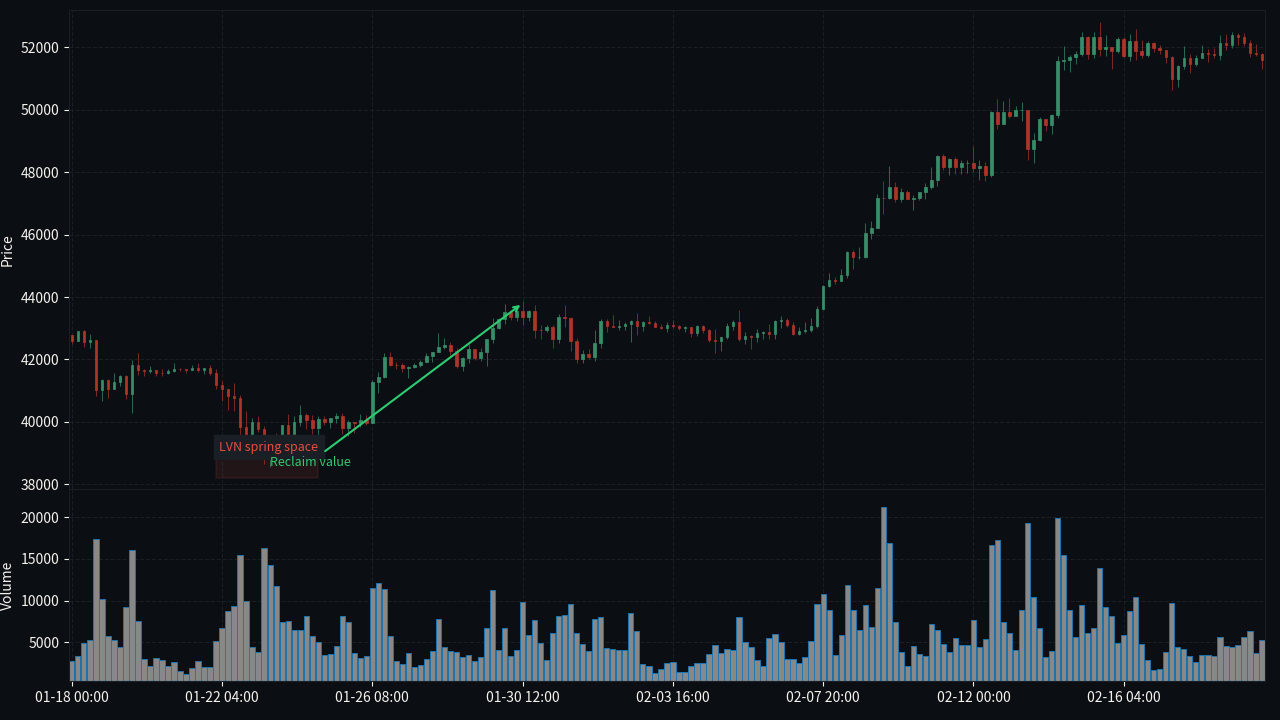
What is the professional first response after BTC/USD drops into the LVN below VAL and quickly reclaims?
6. Profile Must Be Placed in Wyckoff Context
Profile only tells you where business took place. It does not tell you who won. The Wyckoff phase tells you whether that business is stopping a decline, absorbing supply, testing supply, or leaving the range. Lao Wang's sequence is to draw the range first, mark the profile second, and write the candidate last.
In the case, the POC inside the H4 range is stable, the LVN below VAL is rejected, and H4 shows Spring + Test. Only then is there confluence. If there is only POC, without phase and test, it is neutral information. The failure condition is that the range low is lost on expanding volume and the profile redistributes into a lower area.
7. Profile Shift Is the Hardest Invalidation Signal
Many traders treat the old POC as permanent support, which keeps them imagining a long thesis after a breakdown. The operating rule is this: if price stays below the old VAL and forms a new HVN or new POC, the market has accepted lower value. The old profile only has historical meaning.
If BTC/USD H4 breaks below VAL, cannot rally back to the old POC, and then volume concentration shifts lower, Lao Wang cancels the Accumulation thesis. The case is not about flipping short after one wrong read. It is about closing the old long thesis first. Write the failure condition before the trade, so you do not change your wording during execution.
8. Live Drill: Five-Step Markup
Lao Wang's drill is mechanical. First, choose the range start and end. Second, mark POC, VAH, VAL, two HVNs, and one LVN. Third, write the Wyckoff phase candidate. Fourth, wait for Spring / Test / SOS or Upthrust / Test / SOW. Fifth, write invalidation.
If you cannot complete all five steps, skip the setup. Profile easily leads to over-interpretation because you can always find a node on the chart. You are trading the places where profile and Wyckoff behavior synchronize, not every horizontal line.
Mark POC, VAH, VAL, one HVN, and one LVN. Then write the Wyckoff phase candidate and invalidation condition.
Profile first answers where business took place. POC, HVN, and LVN are volume distribution, not automatic trading signals.
Wyckoff determines the behavioral meaning of that business. An HVN inside a TR may be Accumulation, but it must have a Test and invalidation condition.
Profile shift cancels the old script. When a new POC forms lower, the old VAL / POC support assumption must be closed.
Next lesson L2.2: The Three Rules of VSA
How was this lesson?
Your honest feedback decides what we build next.