L1.1 — A Signal Is Not a Strategy
Most retail traders are not first hurt by indicators. They are hurt by their own labels.
They see RSI oversold and call it a strategy. They see a MACD bullish cross and call it a system. They see an engulfing candle and call it a setup. They promote one image, one label, one fragment of a condition into a complete plan that can take risk.
Elena Park would strike that sentence out.
That is not a signal yet. That is a decoration.
The operating definition of a signal is narrow: signal = pattern that triggers IF X. It is only an evidence label that appears when a condition is satisfied. For example, "20 EMA slope up and price closes back above it after pullback" can be a signal. "RSI reclaims from below 30 to above 35" can be a signal. "A pin bar appears at weekly support, and the next candle breaks the pin high" can be a signal.
Notice that every sentence has an IF. Without IF, there is no signal. If all you have is "RSI is low," "the moving averages crossed," "there is a hammer here," or "0.618 has arrived," that is not a signal. It is decoration on the screen.
The definition of strategy is longer: strategy = signal + context + rule + risk + invalidation. Signal is only the first piece of evidence. Context decides which market state can make that evidence valid. Rule decides when activation is allowed. Risk decides how much one mistake can cost. Invalidation decides what proves you wrong.
If any one of those is missing, you are not executing a strategy. You are stamping impulsive trades with attractive terminology.
1. Indicators Are Not Entry Orders
Indicators measure one category of market information. MA measures average price location. RSI measures the ratio of upward to downward force inside a window. MACD measures the change in the spread between two groups of moving averages. ATR measures volatility range. Bollinger Band measures price location relative to mean and standard deviation.
None of them are prediction machines.
When you say "MACD crossed bullish, so buy," you skipped Elena's first question: what does this evidence measure? A bullish cross only says short-term moving-average momentum has begun to exceed long-term moving-average momentum. It does not tell you whether the regime is trending or ranging. It does not tell you whether weekly resistance is overhead. It does not tell you where the stop should go. It does not tell you how this instrument behaved in the last 100 bullish crosses.
So at most it is a witness, not a judge.
In a tribunal, one witness cannot decide the case alone. It can only testify. You must ask what its testimony covers. RSI can be a momentum witness. ATR can be a volatility witness. MA slope can be a trend witness. A candle trigger can be a timing witness.
Treating the witness as the judge is the most common procedural error in retail technical analysis.
2. Patterns Are Not Strategies Either
Candle patterns work the same way. Engulfing, pin bar, inside bar, and doji are not naturally meaningful. They only describe local transaction shape.
A pin bar in the middle of a 5-minute chart, with no key level above or below, no liquidity to the left, and no confirmation to the right, is just noise. An engulfing candle in the center of a daily range is only a coverage relationship between two candles. A doji that appears three minutes before news does not prove market hesitation. It may only mean liquidity has stepped away.
Elena does not ask, "What is this pattern called?" She asks:
- Where did it appear?
- What behavior does it trigger?
- How do you know when it fails?
A pattern enters the evidence table only when location, trigger, and negation are all explicit. Otherwise it is only a pattern-recognition game.
3. Location Is Evidence Weight, Not Decorative Background
The same signal carries completely different weight in different locations.
RSI bullish divergence near higher-timeframe support, while price sweeps the prior low and reclaims, may be auditable reversal evidence. The same divergence in the middle of a downtrend, with no support, no structure shift, and no transaction confirmation, is only slowing momentum during a decline.
MA pullback is the same. Price pulling back to a rising 20 EMA for the first time, after that EMA has been tested repeatedly over the past 50 candles, is dynamic support with context. If price is chopping through the average inside a range and you force the phrase "moving-average pullback" onto it, you are packaging noise as discipline.
Location does not exist to make the chart look better. Location decides whether the evidence is qualified to be heard.
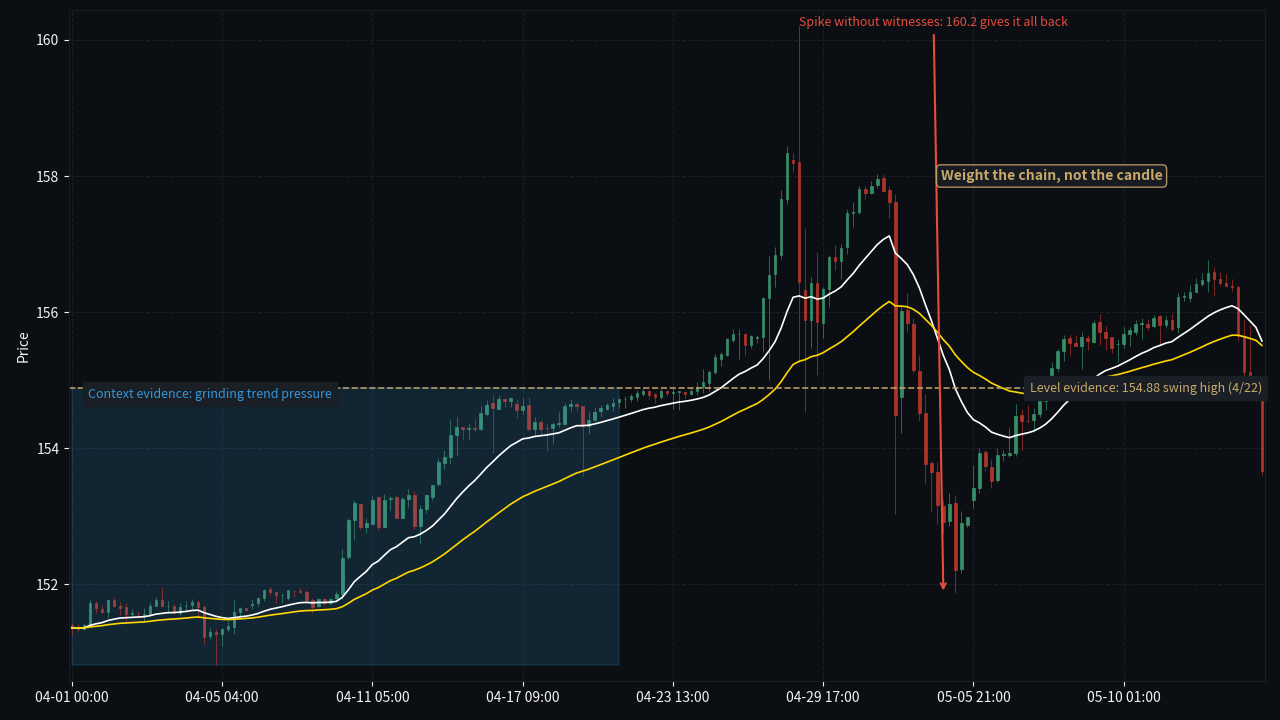
The same 20 EMA pullback appears once as the first pullback in a clear uptrend, and once inside a range where price keeps chopping through it. How would Elena judge the signal?
4. Trigger Is the Threshold from Observation to Action
Signal is not the second you enter. Trigger is the action threshold.
For example:
- Signal: price returns to a daily support zone.
- Trigger: a 15-minute candle closes above the prior swing high.
- Invalidation: close back below the support zone low.
Or:
- Signal: BB width falls into the low percentile of the past 120 candles.
- Trigger: expansion candle closes outside the range, with ATR expanding at the same time.
- Invalidation: breakout candle is reclaimed back into the range within two candles.
Without a trigger, you enter early. Without invalidation, you hold and hope. Without context, you execute a correct rule in the wrong regime.
That is why "trade when you see a signal" is a dangerous sentence. What you see may only be a signal candidate. What can actually be traded is a strategy state.
5. Invalidation Is More Honest Than the Entry Reason
Retail traders like writing entry reasons. They dislike writing invalidation conditions. Entry reasons make people feel smart. Invalidation conditions force them to admit they may be wrong.
The audit view is the opposite. If a signal cannot state its invalidation, it is not allowed into the database.
Invalidation is not the stop amount. The stop amount is risk control. Invalidation is logical failure. Examples include "price closes back below the breakout level," "MA slope turns flat and three consecutive candles close below the average," or "RSI divergence does not lead to a structure shift and price instead makes a new low." These are evidence of logical error.
You can place the stop slightly beyond invalidation to allow room for volatility. But you cannot redefine invalidation as "I think it will come back."
The tribunal accepts only observable evidence. Feelings cannot testify.
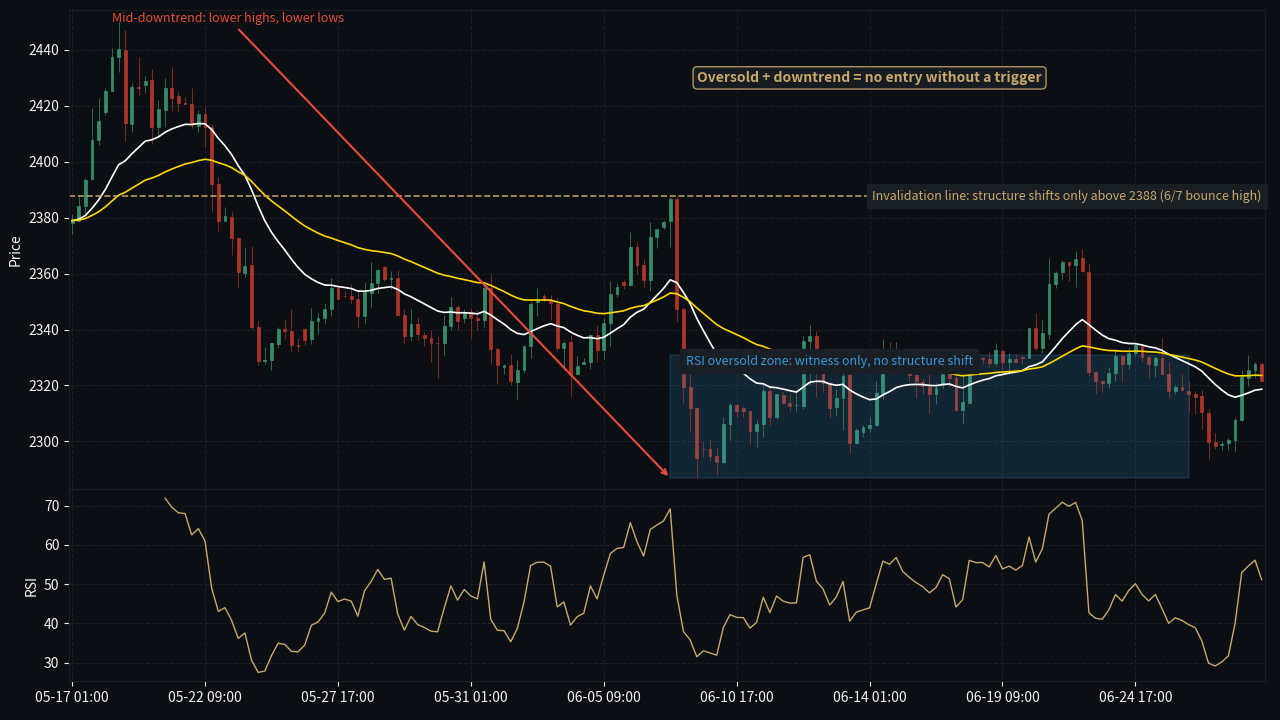
RSI is oversold, but price is mid-downtrend with no structure shift. What would Elena rule?
6. The Minimum Template for This Lesson
Starting today, write anything you want to trade in five lines first:
- Signal: what pattern do I see?
- Measurement: what does it measure?
- Context: in what regime / location is it valid?
- Trigger: what specific event permits action?
- Invalidation: what event proves it wrong?
If you cannot write it, do not trade it. Not because you are stupid, but because the evidence has not formed yet.
This is the entrance to Signal Tribunal. Indicators, patterns, Fibonacci, pivot, and divergence can all be used. The problem is never that the tool is low-grade. The problem is treating an undefined tool as a belief.
Belief cannot be backtested. Definitions can.
7. Three Common Misjudgments
The first misjudgment is treating observation words as action words. "Price is approaching support" is observation. "Price sweeps the low inside the support zone, reclaims, and the 15m closes above the minor high" is the action threshold. Many journals read like weather reports: approaching, strengthening, maybe, feels like. Audit language does not accept those words unless numbers and conditions follow them.
The second misjudgment is treating a win-rate story as a strategy. You may remember three times RSI oversold led to a rally, so you believe RSI oversold works. But you did not record every sample where RSI oversold was followed by further decline. The brain automatically keeps attractive cases and deletes ugly failures. The purpose of a Signal Book is to stop you from replacing samples with memory.
The third misjudgment is leaving risk control until the end. Many people first find a signal, then find reasons, and only at the end ask where the stop should go. The order is wrong. If a signal cannot naturally produce invalidation, it is not suitable for trading. A stop is not a place on the chart that you hope will not be swept. A stop is where your trade hypothesis is falsified.
Elena's note would be short: If the stop is arbitrary, the signal is not operational.
8. Classroom Exercise: Turn Decoration into Signal
Rewrite the three sentences below into qualified definitions:
"MACD bullish cross."
Not qualified. Rewrite as: in a 4H trend regime, the 20 EMA and 50 EMA slopes are aligned upward, and the pullback does not break the prior swing low; the MACD line crosses above the signal line and the histogram turns from negative to positive; the trigger is the next candle closing above the pullback high; invalidation is a close below the pullback low.
"A pin bar appears."
Not qualified. Rewrite as: price reaches the lower edge of a daily support zone and sweeps the prior low, forming a bullish pin with a lower wick at least twice the body, then closes back inside the support zone; the trigger is a later candle breaking the pin high; invalidation is a close below the pin low.
"0.618 has arrived."
Not qualified. Rewrite as: the 0.5-0.618 retracement of an upward impulse overlaps with the prior breakout level and the 20 EMA, while ATR has not expanded abnormally; the trigger is a lower-timeframe reclaim; invalidation is a close below 0.786 or the impulse origin.
Notice that every rewrite became longer. Tradable language is always longer than a slogan. The market does not reduce complexity because your words are brief.
Rewrite the single technical signal on the chart into a five-line definition: signal, measurement, context, trigger, invalidation.
Signal is only an evidence label that satisfies IF X. Strategy is signal + context + rule + risk + invalidation.
Indicators and patterns are not entry orders. They are only witnesses and cannot serve as the judge alone.
Technical analysis without trigger and invalidation is only decoration. Decoration cannot be traded. Definitions can be backtested.